 Product
Specification
Product
Specification  Go To EST Home Page
 General | Overview | Features| Platforms | System Requirements


EASYMAINT evolved from the combined knowledge of engineers of various disciplines and as is based upon the philosophies and functionalities of an internationally acclaimed, mainframe maintenance system.
EASYMAINT was first implemented during 1989 as LAN versions at ten remote sites country wide to manage and control the mechanical plant and equipment of a major transport company in South Africa. During 1991 the system was extended and implemented at a number of sites to also manage and control the maintenance of civil assets. The system has also been successfully applied in the electrical engineering arena.
EASYMAINT allows for the management and control of most maintenance needs, from the planning phase of a major project to normal day-to-day work and emergency maintenance to internal departmental invoicing. The system further allows for private contractor control and includes tender and contractor facilities.
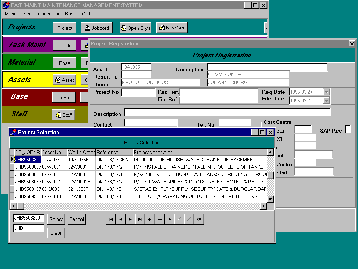
EASYMAINT uses a normalised relational database system. Extensive use is made of standardised user-definable look-up tables, which operate by means of an incremental search facility and hide all meaningless description codes from the user, thus allowing any user to communicate via plain and understandable English.
Unauthorised entry into the system is protected on a menu option selection basis.
A comprehensive on-line electronic help manual is only a keystroke away with detailed user requirements per field always prompted for to clarify the narrative nature of the field and menu descriptions.
The system, though data-driven to a large extent, can also be further customised to each client's specific needs.
User support is only a phone call away as a hotline exists for direct user support.

Personnel
The system allows for the control of standard technical personnel matters such as post hierarchy, salaries, attendance and qualifications.
Resources
The system allows for the control of local resources such as vehicles and plant with a feature to determine utilisation, fuel consumption and even card information such as Nedfleet.
Material
A standard material list with supplier information, stock on hand, requisition facilities, utilisation, etc.
Work Break-Down Structures
The system allows for the defining of standard task structures which, although not essential, automate the maintenance function to a greater extent, with material and resource requirements being specified even for certain emergency work.
Invoice Control
The system includes invoice control facilities which are linked to the
budget system and may be configured to work type level, emergency work or planned work.
Work-in-Progress

Short-term projects (work-in-progress) may be initiated from the
long-term planning facility or by means of the phone-in complaint monitoring system which
automatically issues a job card to initiate corrective action.
A simplified project management facility (resource balancing) is also included to ensure
optimised productivity within prioritised projects. However, interfacing with third party
project management software such as Super Project and MS-Project is equally possible.
Long-Term Planning
This module allows for preventative activities which will ultimately also determine the
condition of the assets controlled. The resource and material needs for periods into the
future will automatically be available for better and more accurate planning. Graphically
the activities are displayed on a GANTT chart. Long-term tasks may be triggered by
calender, elapsed time or meter readings.
Material Management
This module contains a comprehensive material inventory system with
possibilities of sub-stores, min/max levels, etc. Even a commercial vehicle can be
controlled by designating it as a sub-store. Material may be supplied either from local
stores or private contractors. The stores records are automatically updated as material is
issued to the various projects.
Training
Due to the simplified user-interface and structured menu system, training requirements are
minimal and users are guaranteed to be up and running after the three day work-in-progress
training session. The three day course on long-term planning puts users well on their way
to preventative maintenance. During this course a number of sound maintenance policies are
also investigated.
Task breakdown structures are touched during the previous mentioned courses, however, the
three day detailed course on task breakdown configuration is recommended. As effective
material management can be very involved, a three day course on this topic is also
available.
The last three day course is for system administrators to provide the client with an
internal understanding of the system structures and data dictionaries.
It should be noted that it is usual that even completely computer-illiterate persons can
use the system after the first three day course. In some cases depot managers are even
using receptionists to perform the complaint phone-in system - right up to job card
printing level.
Implementation
Phase 1 : Base Configuration. Phase 1 is concerned with the configuration of the
various base files such as the asset base groups and as described above. These files can
normally be created via a semi-electronic process whereby the client's existing
information is extracted from other systems. In the worst case experienced to date, a
comprehensive workable base was compiled within five days. It should be understood that
the system does real-time validations of all the information provided and, although a
large number of the configuration files are not mandatory, greater benefits from the
system will be achievable with the completion of every file.
Phase 2 : Work-in-Progress. Phase 2 is mainly concerned with the accumulation and analysis of historical data. This data is gathered from job cards which reflect work done on assets, as well as from purchase orders and stores requisitions. EASYMAINT can then analyse this data to provide the user with information on how his labour and materials are being utilised and to provide a history on the equipment. The system also identifies problem areas which then can be analysed and ultimately put onto a preventative maintenance cycle.
The planned maintenance tasks generated by long-term scheduling are integrated with breakdowns and day-to-day instructions to produce daily task plans and, again, resource-balanced work-load schedules. Where repetitive tasks are undertaken, master tasks may be set up and called upon as defaults.
All services, inspections, etc are linked to dates and, in addition to the normal daily task lists produced, EASYMAINT prints follow-up reports on all overdue items until they are completed.
The last function of this phase is to produce the operational
documentation used by EASYMAINT - job cards, purchase orders and stores requisitions.
Phase 3 : Long-Term Planning. Phase 3 handles long-term maintenance scheduling. A programme of planned maintenance tasks is produced, typically looking one or more years ahead, together with schedules of the resources required to execute them.
The long-term material requirements produced by this phase, enable the user to manage his stockholdings more efficiently.
Finally, this phase contains a module which allows the user to ask "What if?" questions in order, for example, to evaluate a maintenance programme and to assess its affect on overall costs and availability.
Phase 4 : Maintenance Optimisation The previous two modules are intended to give the user better control of his current operation by supplying analyses of equipment availability and maintenance costing.
These reports allow the user to measure his equipment availability against his production requirements and to concentrate on action areas where maximum results can be obtained with a minimum of effort. Deviations from cost budgets are highlighted and potential problem areas pinpointed.
This phase also concludes the maintenance cycle as preventative
activities can now be adjusted for optimum cost-effectiveness without forfeiting quality.
EASYMAINT Generator
The system includes a system generator which may be used to effect global changes to the
system as and when required, set up relations at will and to perform queries.
Also included is a comprehensive report generator to allow the user to extract his own
exception reports at will. It should be noted that the standard system includes a host of
maintenance reports with supporting graphs and pie charts allowing users to produce
management information without the need of the knowledge of any third party products.
Benefits
· Because the system evolved from the experience of a team of engineers who designed it
together with actual users, it is totally relevant to the many and varied requirements of
successful maintenance management.
· Due to the minimal training requirements and ease of configuration of the system, tangible benefits can be realised soon after implementation.
· The effects of changing operational conditions - especially unforseen occurrences such as breakdowns - can be immediately evaluated and alternative actions can be assessed and implemented without delay.
· The system is totally modular in structure. The user can, therefore, initially implement only that part of the system most relevant to his immediate needs. When this is fully operational, the user can expand the system by simply adding further phases, thereby deriving enhanced benefits.
· Relevant reports to stimulate pro-active management can be obtained as soon as the system is installed and the first project is registered.
· Wherever possible, EASYMAINT uses plain, everyday language, which means that reports generated are readily understood by the people who need to use them.
· The maintenance performance reports shows valuable trends such as:
Integration with other Systems
The system currently down-loads labour information to an IBM
mainframe financial system as well as summarised project information to the Mentor
Unix-based Property Management System.
Integration to other software systems such as project management software, spreadsheets,
etc. are also possible.
Scaleable systems are available which will run on DBASE III, Paradox, Interbase, MS SQL, Oracle , etc. on a single PC to Client Server environments.
|
Computer Server : Pentium III 450 MHz Workstation : Pentium II 133 MHz |
|
Memory Server : 64 MB RAM Workstation : 32 MB RAM |
|
Hard Disk Capacity Server : 10 GB Workstation : From 3.2 GB |
|
Display VGA or higher resolution graphics card, Colour VGA Monitor |
|
Operating System Server : NETWARE 4.1, Windows NT, O/S 2 Workstation : MS-DOS ® 6.22 and Windows 3 1 or Windows 95/98 and Windows NT |
|
Peripherals Microsoft Mouse or compatible pointing device Modem/FAX Dot Matrix/Laser Printer |
© 1996, Easy Systems Technology, CC. Email webmaster@est.com
with comments.


